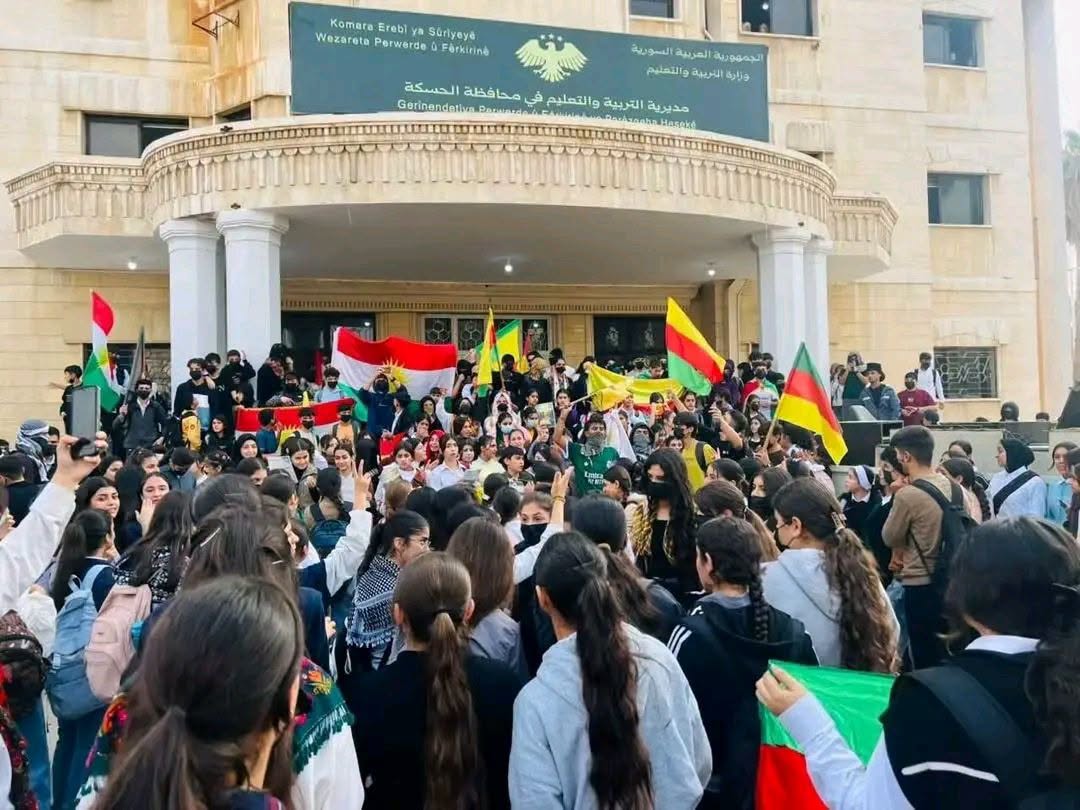
A peaceful demonstration in front of the Governorate Headquarters was met with stone-throwing and firing in the air, with documented slaughter threats and escalation against students for raising Kurdish flags and symbols.
The city of Hasakah witnessed an escalation against Kurdish students who took part in a peaceful demonstration demanding their right to receive education in their mother tongue. The students were subjected to stone-throwing, assaults, and threats amid altercations with youths from the Ghuwayran and Al-Nashwa neighborhoods, while the Internal Security Forces fired shots into the air to disperse the crowds.
According to testimonies reported by Hawar News Agency from the students, groups arriving from the Ghuwayran neighborhood attacked the demonstrators with stones and bladed weapons during their protest in front of the Governorate Headquarters, after their demonstration had set off from outside the Education Directorate building in the city center.
The students expressed their outrage at being targeted despite the peaceful nature of their movement, asking: “What wrong did we commit to be suppressed and prevented from peaceful demonstration, merely for demanding our right to our language?”
They stressed that their protest aimed to express their educational and linguistic demands peacefully, emphasizing that the attacks they faced would not deter them from giving up their right to learn in their mother tongue.
Slaughter Threats and Incitement Over Kurdish Symbols
In a related context, the Syrian Observatory for Human Rights (SOHR) disclosed that it had obtained video recordings documenting escalating threats and incitement against Kurdish students in Hasakah, following their participation in the demonstration demanding mother-tongue education and their raising of Kurdish flags and symbols.
One of the recordings showed a masked individual making gestures suggesting slaughter toward the Kurdish demonstrators—a scene the Observatory categorized as a direct threat to their safety. Another recording documented a verbal altercation between a female journalist and a young man from the Ghuwayran neighborhood, featuring threats of further escalation should the student actions continue.
According to information reported by SOHR, the young man justified his threats by pointing to the students’ raising of Kurdish flags and symbols. Meanwhile, security personnel were deployed in the area, though the recordings showed no clear intervention to stop the threats or provide protection to the students and participants.
The attacks later expanded to the vicinity of the Education Directorate building in central Hasakah, where several youths headed to the location and assaulted the Kurdish students gathered outside.
Additionally, a media photojournalist and an Internal Security Forces member were injured after being hit by thrown stones following the altercations that broke out in front of the Governorate Headquarters.
These protests come amidst ongoing disagreement over the future of Kurdish-language education in Syria, following decades of restrictions imposed by the former Syrian regime on the use of the Kurdish language in educational institutions and public life. Discriminatory policies—particularly those associated with the 1962 Hasakah census—had contributed to depriving large numbers of Kurds of Syrian citizenship and other civil and cultural rights.
On January 16, 2026, Syrian President Ahmed al-Sharaa issued Decree No. 13, which recognized Kurds as an integral part of the Syrian people and the Kurdish language as a national language. The decree permitted its teaching in public and private schools in regions where Kurds constitute a significant proportion of the population, within elective curricula or educational and cultural activities.
However, the debate did not end with the issuance of the decree, as representatives of the Autonomous Administration and Kurdish political forces maintain that education in the mother tongue must be guaranteed more broadly, rather than restricting Kurdish language instruction to an elective subject within the Arabic curriculum.
Note: This text is translated from the original Arabic version… Read the Arabic version:Click here