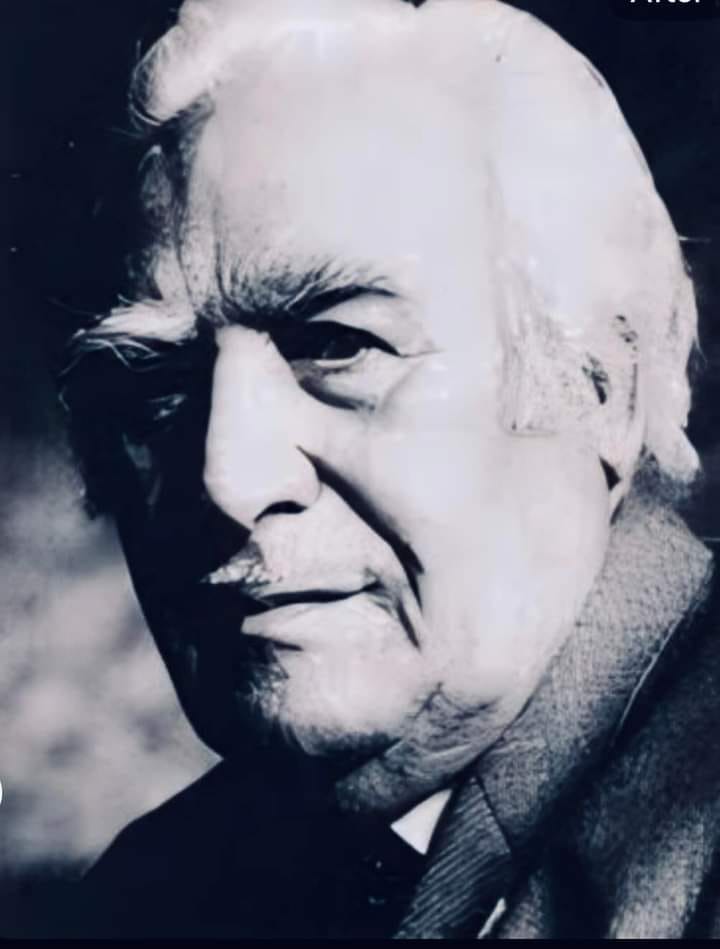
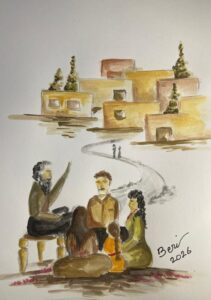
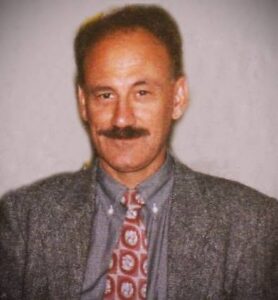
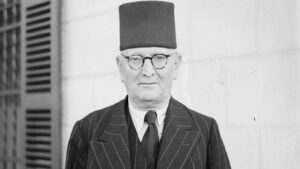
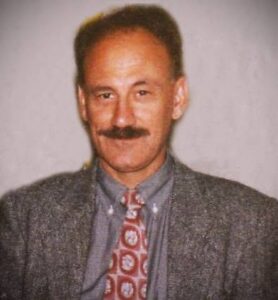
On the twenty-second of October each year, the Kurds commemorate the passing of one of their most prominent literary and cultural figures of the twentieth century, the great poet Cegerxwîn, who departed this life in Stockholm in 1984, leaving behind a poetic and intellectual legacy that transcended the boundaries of literature to become part of the national and cultural memory of the Kurdish people. Cegerxwîn was not a poet writing about pain from afar; rather, he was the son of that pain, having lived through poverty, deprivation, and exile, and witnessed the suffering of his people and the marginalization and exclusion of their language and identity. Therefore, his poems emerged as a blend of human sentiment, national consciousness, and social awareness, serving as a voice for peasants, laborers, and the underprivileged, and for a people who continuously struggled for the recognition of their language, rights, and identity. Commemorating his life on the anniversary of his passing is not merely a moment to reflect on the experience of a great poet, but a return to an important phase in the history of the modern Kurdish cultural and political renaissance.
Birth and Upbringing.. From Hesarê to Rojava
Cegerxwîn was born in 1903 in the village of Hesarê, located near the city of Êleh “Batman” in Bakur Kurdistan. His real name was Sheikhmous Hassan, and he grew up in a poor family, enduring a harsh childhood during which he lost his parents at an early age and was forced to confront difficult life conditions early on. Circumstances did not afford him the opportunity to receive a regular modern school education; however, he received traditional religious schooling, learned to read and write, and subsequently traveled among religious schools across various parts of Kurdistan in pursuit of knowledge and learning.
The social environment in which he lived, along with the poverty, suffering, and deprivation it entailed, was a primary factor in shaping his early consciousness. He became acquainted with the lives of peasants and laborers, lived through the details of daily life in Kurdish villages, and listened to the folk tales, songs, and poems passed down through generations. From this environment, the features of his literary persona began to form, before his personal experiences transformed into a poetic vision expressing the suffering of an entire society. Following the First World War, his family moved to Rojava and settled near the city of Amuda, where a new stage of his life began, in which his personal experience became closely tied to the social, cultural, and political reality of the Kurds in Syria.
From Mullah to Poet.. When the Poem Transcended the Pulpit
Cegerxwîn studied religious sciences in traditional schools and became a Mullah (cleric), working between approximately 1928 and 1936 in several Kurdish villages, where he performed his religious and social duties and communicated directly with community members. However, his daily contact with peasants and the poor, along with the social inequality, injustice, and deprivation he witnessed, gradually drove him to expand his interests from the religious realm to the cultural, social, and political spheres. He realized that people’s lives were not determined by preaching alone, and that poverty, ignorance, and oppression required an awareness that went beyond the bounds of traditional discourse.
During that phase, he began writing poetry, taking the Kurdish language as a tool to express the concerns and hopes of the people. For him, the poem was no longer merely a means for expressing individual emotions, but was transformed into a vehicle for raising awareness and defending dignity, rights, and identity.
As for his pen name “Cegerxwîn,” it carries a deep emotional significance in the Kurdish language, referring to the bleeding liver or the heart bleeding with pain—an image fitting for his personal experience and for the pain of his people that his poetry bore. His poetic identity materialized within a historical context that witnessed profound transformations in Kurdistan, particularly after the suppression of Sheikh Said Piran’s revolt in 1925, and the subsequent persecutions, unrest, and displacement that left an impact on his national and social consciousness.
Influence of Kurdish Heritage and Openness to Modern Thought
Cegerxwîn’s poetic journey did not emerge from a vacuum; rather, it relied on a rich Kurdish literary heritage, foremost among which were the works of the great poet Ahmad Khani, alongside the traditions of classical Kurdish poetry and inherited folklore. He drew upon this heritage to construct his poetic language and artistic imagery, but he did not settle for merely repeating old methods. Instead, he sought to renew the function and themes of poetry, shifting it from the realm of traditional ghazal and contemplation to issues of society, freedom, justice, and national identity.
He was also influenced by the intellectual and political transformations the region witnessed in the first half of the twentieth century, and by social ideas that placed the poor and laborers at the core of understanding society. Hence, his poetry combined national spirit with an interest in social justice, and pride in heritage with a call for change. His language was clear and direct in many of his poems, close to the language of the people, which facilitated its dissemination among various social classes. He intended for poetry to reach the peasant, the worker, the woman, and the youth, rather than remaining confined to cultural elites.
From Poetry to Political Action.. Participation in the Kurdish Renaissance
Cegerxwîn did not separate his literary activity from his engagement with public affairs; rather, he viewed culture as part of society’s battle for awareness and rights. He participated in Kurdish cultural and political activities, contributing to the establishment of associations and organizations aimed at reviving Kurdish identity and enhancing national and cultural awareness, standing among the figures who linked the literary renaissance to national action. He also engaged in political work, and his name became associated with stages in the development of the Kurdish political movement in Syria, where he participated in founding the Kurdish Democratic Party in Syria in 1957. Throughout his life, he faced persecution and arrest, yet he continued his political and cultural struggle, believing that defending the homeland—alongside political struggle—required defending language and culture, which was no less important than other forms of struggle.
The 1954 Qamishli March.. When Demands Moved from Poem to Street
Cegerxwîn’s participation in the first Kurdish demonstration in the city of Qamishli in 1954 holds a significant place in the memory of the Kurdish national movement in Syria. Regarding this, the Kurdish national figure “Kazem Hussein As’ad” writes in his book My Memoirs, published in Qamishli in 2024, stating: “In 1954, following the coup of Adib Shishakli who ruled Syria (1949-1954), while he was distributing land to peasants and turning a blind eye to Kurdish rights, we—the Kurds who were peace advocates and close to the Syrian Communist Party—demanded our cultural rights.. The Communist Party in the Jazira region was active among all communities in the city under the leadership of Arakel the Armenian.. We formed a delegation and presented our demands to Arakel in the presence of his two comrades Hussein Amr and Osman Berro, as well as other Kurdish and Christian communists.. Our delegation included: the poet Cegerxwîn, Mullah Sheikhmous Qarqati, Mullah Sheikhmous Sheikhi, Mullah Ramadan Barzanji, and Kazem Hussein As’ad.. After deliberation, Arakel and his comrades suggested that we organize a mass rally with the support of the Communist Party to demand our cultural rights.. Initially, we were to direct our rally toward the Saray and present our demands to the district administration, where the district governor was Adham Ukash.. We agreed that Cegerxwîn would read the text of the demands, which were focused on the Kurdish language and cultural rights.. And so it happened.. We set off in a march.. More than 500 people participated, among whom were Farhan Hasso, Mullah Sabri, Farhan As’ad, Khalil Anz, Hussein Anz, and Ibrahim Suleiman.. About 200 meters before reaching the Saray, we were intercepted by members of the Second Bureau led by Brigadier General As’ad al-Hakim.. After immense effort, we managed to reach the door of the governor’s office, which had been locked in our faces.. The door was broken open, and we entered to face the governor and his group amidst their astonishment.. And he read our cultural demands to them.”
Poetry Collections.. Eight Works in the Memory of Kurdish Literature
Cegerxwîn left behind a rich poetic legacy, and his eight collections are considered among the most prominent milestones in the evolution of modern Kurdish poetry in the Kurmanji dialect. Among his most famous collections are:
Prîsk û Pêtî: published in 1945.
Sewra Azadî: published in 1954.
Kî me Ez?: published in 1973.
Ronak: published in 1980.
Zend-Avista: published in 1981.
Şefeq: published in 1982.
Hêvî: published in 1983.
Aştî: published in 1985 after his passing.
As a whole, these collections reveal a diverse poetic trajectory that blends national and social issues, reflection on life and humanity, and expressions of love, hope, and pain. Key themes prominently emerge within them, including the defense of the Kurdish language, criticism of social injustice, resistance to tyranny, and calls for freedom and justice.
From Qamishli to Sweden.. The Final Exile
After decades of literary, cultural, and political work, Cegerxwîn departed Syria for Sweden in 1979, leaving from the city of Qamishli during a period marked by political hardships and restrictions surrounding Kurdish cultural activity. His move to Sweden marked a new phase in his life, but it was not a disconnection from Kurdistan or the cause of his people. There, he continued writing and publishing, releasing new collections that reflected his ongoing preoccupation with freedom, identity, and humanity.
Despite the geographical distance separating him from Rojava, Kurdistan remained present in his poetry, and the Kurdish language remained his primary medium for expressing his belonging. His final years allowed him to continue his literary project, leading to the publication of collections in Sweden such as “Ronak,” “Zend-Avista,” “Şefeq,” and “Hêvî.” Thus, exile did not become an end to his journey, but rather another phase of his contributions, during which he preserved his connection to his language and culture, continuing to write until he passed away in Stockholm on October 22, 1984.
Departure in Stockholm.. And the Final Return to Qamishli
Cegerxwîn passed away in the Swedish capital, Stockholm, at the age of eighty-one, after a life full of writing, cultural work, and political activity. However, his passing in exile was not the end of his relationship with Kurdistan; his body was transported to the city of Qamishli, where he was laid to rest in the courtyard of his home amid widespread popular participation that reflected his status in the hearts of the region’s people. Today, his tomb still stands in the Western Neighborhood of Qamishli, in the courtyard of his house, serving as a testament to the poet’s connection to the place that hosted a fundamental part of his life and activity. This grave acquires a symbolic significance beyond being a place of burial; it represents the poet’s return to the land where he lived, connected with its people, and wrote in their language about their pains and dreams. He spent his final years far from his homeland, yet he returned to it on his final journey, as if his life summarized a long path of displacement, exile, and return to one’s roots.
Cegerxwîn.. A Legacy Unbound by Years
Decades after his passing, Cegerxwîn remains present in Kurdish memory, not merely as a great poet, but as one of the voices that contributed to building modern Kurdish cultural and national consciousness. He combined poetry, cultural work, and political action, uniting dedication to language with the defense of human rights and social justice, succeeding in turning his personal experiences into literary expression of his people’s hopes and suffering. Perhaps the most distinguishing aspect of his experience is that he never separated language from identity, literature from life, or the poet from his responsibilities toward his community. Cegerxwîn wrote in Kurdish at a time when writing in this language bore deep cultural and national dimensions, turning the poem into a means of preserving memory, conveying suffering, and expressing the aspiration for freedom and dignity.
In conclusion, on the anniversary of his passing, we can only say that the need remains to reread his works critically and historically, document his biography, writings, and the testimonies of his contemporaries, and translate his output into other languages so that the world may become acquainted with a literary experience forming an important part of Kurdish cultural history. For a great poet does not depart when his heart stops beating; rather, he remains alive as long as his words are capable of touching people’s feelings, and as long as his people find in his poems a part of their history, pain, and hope. In Qamishli, where Cegerxwîn’s body rests in the courtyard of his house, his memory remains present, and his poems remain a testament that the sincere word can cross the boundaries of time and exile, transforming into a part of the memory of a people who do not forget their poets who carried their voice to the world.
Ronahi Newspaper
Note: This text is translated from the original Arabic version… Read the Arabic version:Click here