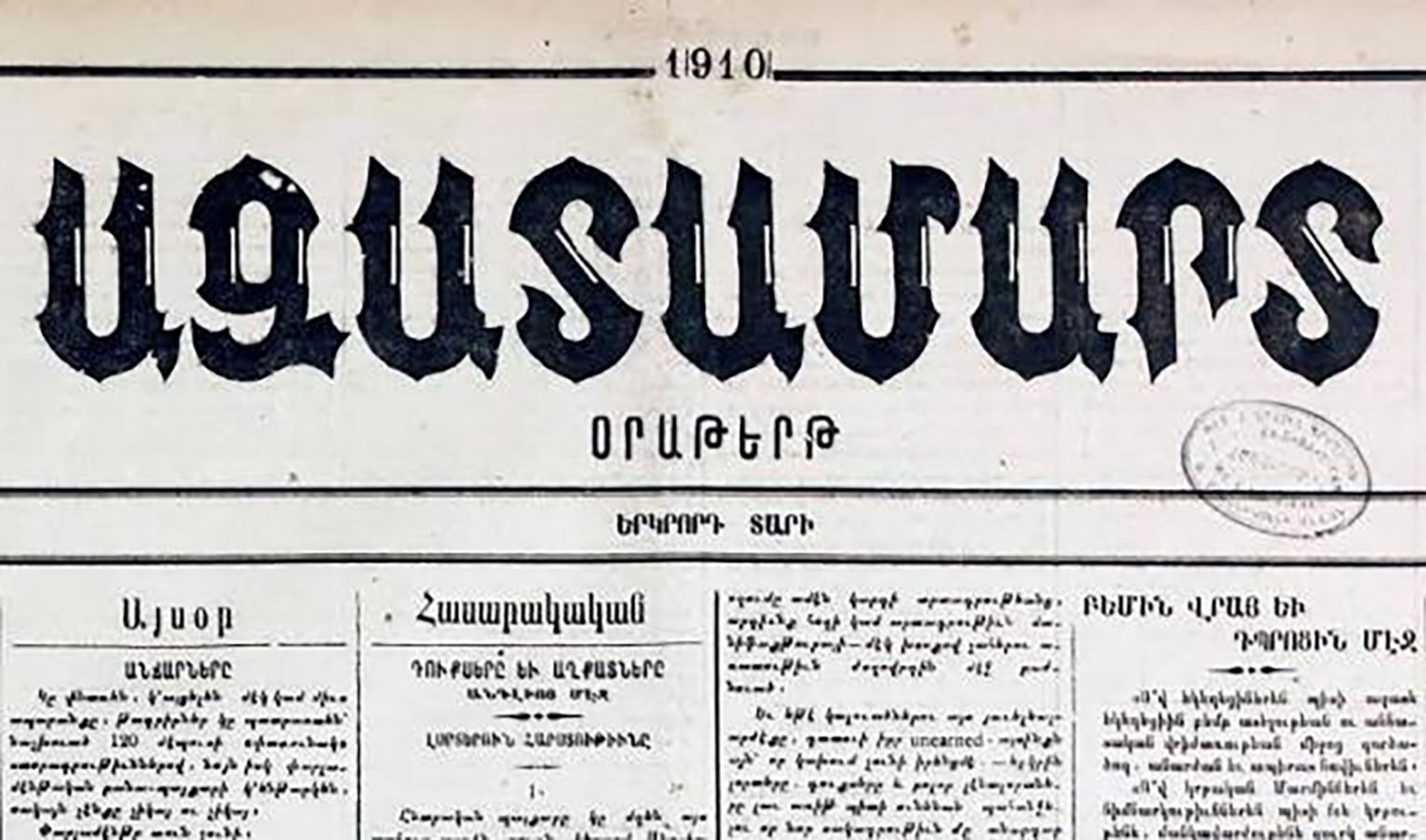
We continue reviewing the news reports, letters, and commentaries concerning the Kurds published in the “Azadamard” newspaper. A large portion of this material is devoted to information about Kurdish tribal leaders, aghas, and beys; their mutual relations, conflicts, dealings with the government, and particularly their shifting attitudes toward the Armenians reveal information worthy of attention.
The news reports also include numerous accounts regarding the presence of Kurds in various regions of Iran, Iraq, Syria, and Turkey, addressing aspects of their social, political, and economic life. We can observe that dozens of Kurdish organizations existing in the Middle East today trace their roots back specifically to that historical period.
The press reflects a view holding that armed Kurds were behind all of this and that, owing to the power they possessed, they engaged in uncontrolled, illegal, and unjust practices that brought harm upon themselves as well, a matter that rendered the dismantling and disarmament of their formations a necessity.
As I previously pointed out, talk of the “peace process” in Turkey with the armed Kurdish organization, the “Kurdistan Workers’ Party” (PKK), was what prompted me to write this series of articles; a major question occupied my mind: Did history witness a similar process? And had the issue of laying down arms and disarming the Kurds been put on the agenda before? “Azadamard” newspaper, published in 1910, mentions that the government addressed this issue seriously, under the title: “Anatolian Security and the Disarmament of the Kurds”.
Excerpts from “Azadamard” Newspaper
1910, Issue 198
Report titled “Kurdish Tribal Leaders on the Border”. Other reports address the social and political situation of the Kurds in Turkey, the crossing of a number of Kurdish tribal leaders over the Turkish-Iranian border, and the occurrence of clashes between Kurdish and Iranian armed detachments.
1910, Issue 208
Article titled “The Kurdish Danger”. The topic addresses the arming of Kurdish tribal leaders.
1910, Issue 215
Report titled “Violations by Kurdish Chieftainships”. The topic addresses the seizure of Armenian lands in the “Muş” region and a number of villages by Kurdish “aghas” and “beys”.
1910, Issue 216
Report titled “Kurdish Movements”. Discusses the spread of preliminary preparations for a Kurdish movement in the vilayets of “Bitlis” and “Van” led by Abdullah Kagri (a pivotal figure who led the preliminary national movements and preparations against the Ottoman government in the vilayets of Bitlis and Van – most likely Abdulkadir Nehri, Translator), son of Sheikh Ubeydullah.
1910, Issue 226
Report titled “Activities of Tribal Leaders”; discusses Kurdish tribal leaders—such as Haydar Bey, Seyid Ali, Seyid Musa, and others—making preliminary preparations to launch new Kurdish operations.
1910, Issue 228
“Meeting of Kurdish Tribal Leaders”: The report addresses a meeting of Kurdish tribal leaders in the “Varto” region and its villages (Muş Vilayet – Translator), aimed at launching new movements against the Turkish government.
1910, Issue 230
“Tribal Conspiracies, Intrigues”. (Containing the phrase “from our special correspondent”). The report discusses meetings held by Kurdish tribes in “Bitlis” aimed at launching a new Kurdish movement.
1910, Issue 232
Report titled “The Armenian and Kurdish Peoples Raise Their Voice Regarding the Land Issue”; discusses a telegram sent by 120 peasants (Kurdish and Armenian) from the “Malazgirt” region (a town in Muş Vilayet – Translator) to the “Bitlis” vilayet regarding the seizure of their lands.
1910, No. 243
Report titled “Tribal Terror” addressing the activities of Haydar Bey (from the Dersim region) in the area extending from “Kiğı” (Bingöl Vilayet – Translator) to “Kemah” (Erzincan Vilayet – Translator), in addition to the Turkish government’s apprehensions regarding these activities.
1910, No. 262
Report titled “Kurdish Movements on the Turkish-Iranian Border” containing details about a Kurdish meeting held on the Turkish-Iranian border led by Sheikh Abdullah. There is also a separate report titled “The Issue of a New Rebellion Breaking Out”.
1910, No. 262
Report titled “The Kurdish Laborer Also Protests Against the Feudal Bey” discussing the social and economic conditions of the Kurds. There is also a report titled “The Chaos Caused by the Kurdish Aghas Huseyin and Hasan in Sasun”. (Batman Vilayet – Translator)
1910, No. 266
Article titled “The Need for Kurdish Literature” discussing Kurdish-Armenian friendship and efforts made to prepare a primer (educational alphabet) for the Kurds using Armenian letters.
1910, No. 296
Report titled “Yezidis’ Appeal to the Armenian Church” reporting that 3,000 Yezidis in Diyarbakır applied to the Armenian Church to convert to Christianity.
1910, No. 317
Report titled “The Kurdish Laborer Against the Aghas” containing a letter sent by Kurdish peasants from the village of “Şerefhan” in Diyarbakır Vilayet to “Azadamard” newspaper, in which they describe being subjected to oppression and injustice at the hands of the local administration and Kurdish aghas.
1910, No. 321
Under the title “Protest by Kurds, Turks, and Armenians”, a letter sent by 124 peasants (Armenians, Kurds, and Turks) from “Bayburt” Vilayet to “Azadamard” newspaper was published, addressing the acts of looting and pillaging taking place in the region. Other reports addressed the activities of “Haji Suleyman Agha”, Kurdish protests against “Suleyman Satikh”, and protests by the inhabitants of the village of “Zanbig” in “Eleşkirt” (Ağrı Vilayet – Translator) against the local administration.
Anatolian Security: Disarming the Kurds
(This is a condensed summary of an unsigned analysis published in issue 275 of Azadamard newspaper in 1910):
The government intends to address the issue of disarming the Kurds in Anatolia in a radical manner. Resolving this issue had been a necessity for the state for more than thirty years, yet it became an inescapable imperative following the new regime established by the July Revolution [referring to the 1908 revolution that deposed Sultan Abdulhamid II and marked the arrival of the Young Turk movement, represented by its political organization known as the Committee of Union and Progress, to power – Translator]. This necessity aimed not only to protect the lives and livelihoods of the peaceful population, but also to reform and civilize this unruly element. The interests of the Kurdish people themselves likewise dictate the definitive collection of remaining weapons; failure to take this measure means these weapons will remain a curse upon the Kurdish people themselves.
It is permissible to say that the right to existence is automatically forfeited by groups that pose a threat, and by destructive and subversive elements. Therefore, all Kurdish intellectuals—whether working in civil administrations or in the army, and whether in Istanbul or in the provinces—are expected to support this government initiative, stemming from the supreme national interests of their people, to usher in a new era of life and constructive work for the Kurdish population in Anatolia. The Middle Ages, with their heavily armed bands, acts of looting and destruction, and continuous wars, have passed once and for all—for all nations, whether in Europe, Asia, or even the depths of Africa. Today, a nation seeking an aim in life can rely on tools of labor, not tools of destruction; yet a large segment of the Kurdish population neither possesses these tools nor has any acquaintance with them.
The greatest calamity lies in the fact that these Kurdish tribes—who engage in hit-and-run tactics and live a life of nomadism and unemployment—constitute a source of affliction for the hardworking Kurdish peasants in the plains, just as they do for the hardworking Armenian population.
The Kurdish peasant lives as a humiliated slave under the weight of the “aghas” and the miserable feudal system they established; the sword of the aghas, their own kinsmen, falls with that very weight upon the necks and shoulders of the Kurdish peasants. The unarmed peasant possesses no guarantee to protect the fruits of his labor or his dignity; the tyrannical sway of the agha has paralyzed the hands of the workers, whether Armenian or Kurdish. By draining the blood of others, he has transformed these provinces—which could have flourished anew and become a paradise—into a hell; whereas all that is required is forcing the Kurd to return his sword to its sheath.
The general disarmament program can be considered the smartest reform applied by the constitutional regime in Anatolia; the only regret is that its implementation has been delayed all this time. Through this decisive measure alone will the executive power be able to put an end to the feudal system and eradicate that unjust and illegal system known as a “state within a state”. In this manner, it will guarantee the peaceful population’s right to life, security, and development, and direct Kurdish plunderers toward integration into society and honorable, productive labor.
We hope that as soon as the government seeks to achieve this goal with a firm will, and prevents the carrying of arms and the movements of Kurdish bandits—whether individually or in groups—by imposing the strictest measures and penalties, it will deal a fatal blow to the influence of many notorious criminals operating under various names.
The disarmament program cannot achieve its desired results except under one condition: pursuing its implementation firmly, accompanied by honest, impartial cooperation!
Source: Madarat Kurd
Note: This text is translated from the original Arabic version… Read the Arabic version:Click here