The General Commander of the Syrian Democratic Forces, General Mazloum Abdi, confirmed that the implementation of the integration agreement with the Syrian government is moving forward, with practical steps being taken to consolidate the ceasefire and integrate institutions and forces. At the same time, he warned of the rise in hate speech and stressed that the primary goal is “to make the agreement succeed and establish lasting peace.”
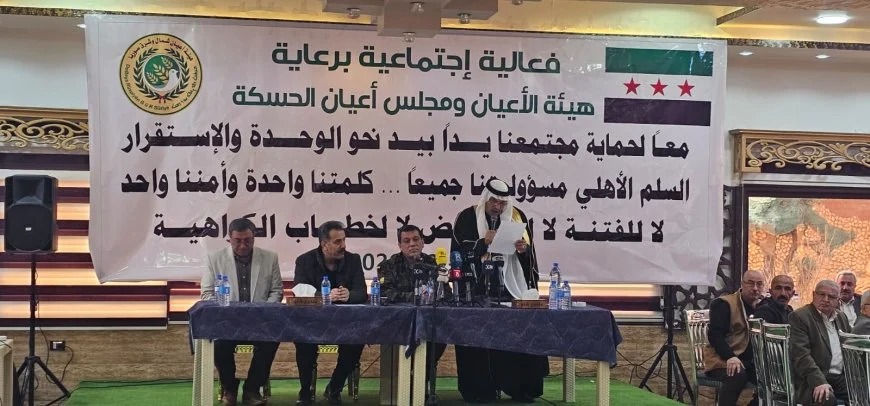
Abdi’s statements came today, Tuesday (February 17, 2026), during a meeting organized by the Council of Elders and the Hasakah Elders Council at Shtu Hall in the city of Hasakah, in the presence of representatives of Arab and Kurdish tribes and other components, along with social, cultural, and political figures.
Abdi revealed that he held a meeting with Syrian Foreign Minister Asaad al-Shaibani and the head of the General Intelligence Service, Hussein al-Salama, noting that “two committees have been formed from both sides at the leadership level, and they will meet in the near future.”
He added that “the security forces that arrived in Hasakah Governorate are working to complete the integration process,” confirming that “a committee has been formed from both sides at the leadership level, and they will supervise the integration process during the coming short period.”
He explained that it was agreed with Damascus to integrate the Syrian Democratic Forces into brigades of the Syrian Ministry of Defense, saying: “We were keen to preserve all our fighters who participated in confronting terrorism and made sacrifices,” pointing to “an issue regarding the appointment of the Deputy Minister of Defense in Damascus, and we are now working to announce that officially.”
He stressed the necessity that “members of the Internal Security Forces (Asayish) and their directors maintain their positions within the structure of the Syrian Ministry of Interior.”
Abdi indicated that the agreement signed on January 29, 2026, has achieved tangible progress, saying: “In general, we can say that we are moving forward with implementing the agreement.”
He added that all forces in Hasakah “withdrew” to their barracks and were replaced by the “security forces,” stressing the need for the “withdrawal of military forces from the countryside of Kobani to their barracks and the lifting of the siege imposed on the region.”
He also clarified that the integration “does not concern only the Kurdish component, but the most important aspect is the integration of all institutions of the Autonomous Administration into the structure of the Syrian state, while there will be a specificity for Kurdish-majority areas,” adding: “We have institutions that have existed for more than 12 years, and these institutions will retain their directors and members while being integrated into the structure of the Syrian state.”
He confirmed that the administration of Hasakah Governorate will be shared among all its components, saying: “All components of Hasakah Governorate will manage this governorate together within the new structure, and there will be specificity for the Syriac-Assyrian component in their villages and areas, as well as for the Kurdish component.”
Abdi pointed to international support for implementing the agreement, saying: “All countries concerned with the Syrian issue are interested in implementing the agreement concluded between the SDF and Damascus, which aimed to establish a ceasefire and declare a permanent truce. During our meetings with international parties in Munich, they confirmed that everyone is against war and fighting, and that the agreement must be implemented.”
He warned of the rise in inciting rhetoric, saying: “We have noticed inciting and hateful rhetoric in the recent period, and this is something strange to us in Jazira, the areas of Aleppo, and other regions… and now they will not succeed either. We will build this governorate together, and we will all participate in these institutions and administration.”
He added: “We made mistakes in the past and saw their consequences, and we will draw lessons from them for the next phase. Currently, the most important thing is the future and working for it, and we do not want anyone to feel frustrated or adopt negative positions.”
On the issue of the displaced, Abdi announced the formation of a special committee, saying: “Regarding the displaced from Afrin, Serekaniye, Tel Abyad, Sheikh Maqsoud, and Ashrafiyeh, we decided to form a committee that will begin its work tomorrow or the day after tomorrow to develop a roadmap for the return of the displaced,” adding: “To ensure the return of the displaced, we decided to form a committee and appoint certain individuals to discuss the return issue and be responsible in their areas.”
The meeting concluded with a statement affirming that Hasakah “will remain a land of coexistence and brotherhood and will never be an arena for strife, incitement, or hate speech,” stressing commitment to implementing agreements, rejecting hate speech, strengthening dialogue, preserving the unity of the social fabric, and renewing the pledge to joint work “toward unity and stability.”
Read the Arabic version: Click here