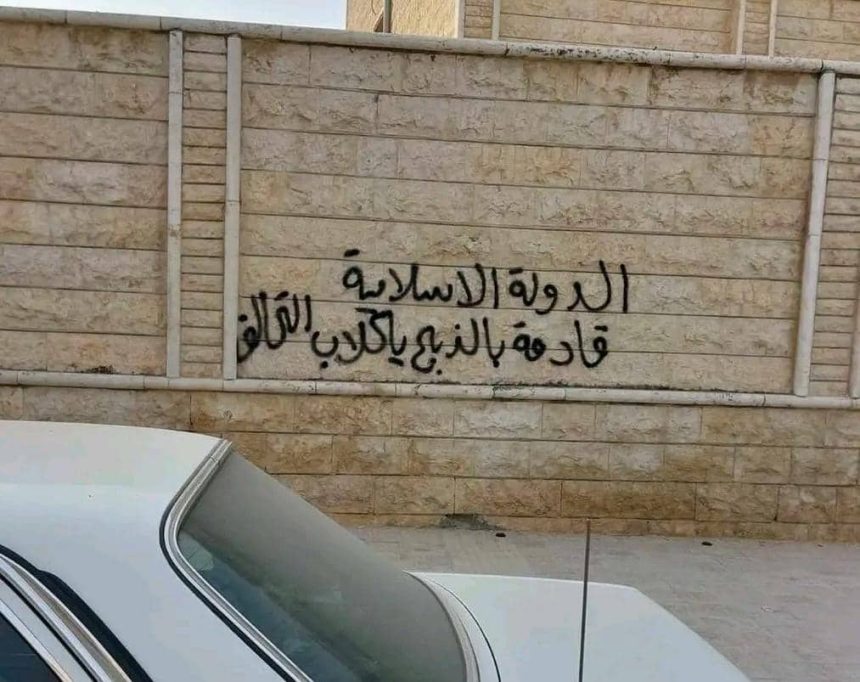
The escalation of ISIS activity in Syria cannot be treated as a passing development that can simply be categorized under the label of “sleeper cells” that periodically emerge and then fade away. What is unfolding today reflects a qualitative shift in the balance of control and reveals the collapse of an entire security system that had, for years, represented the most effective barrier against the group’s resurgence.
Over the past years, the Syrian Democratic Forces (SDF) succeeded in undermining ISIS’s operational structure not only through direct military confrontation but also through a sophisticated and complex intelligence campaign. Extensive networks of informants, internal infiltrations, monitoring of financial flows and movements, and daily coordination with the international coalition all transformed vast areas of eastern Syria into an environment hostile to the organization, significantly limiting its ability to move, recruit, and plan. The group still existed, but it was restrained, closely monitored, and confined to narrow spaces.
Today, the picture appears reversed.
The reappearance of ISIS’s spokesperson after a long period of silence is not merely propaganda. In the organization’s doctrine, the official voice is not simply a media message; it is an operational signal and a moral and organizational directive to its cells. His return indicates that the leadership senses the existence of a favorable ground and believes that the conditions are now suitable for a new phase of escalation.
The wide and sudden attacks carried out by what is called the “New Syrian Army” on the provinces of Raqqa, Deir ez-Zor, Hasakah, and Kobani led to the collapse of the security system that had been regulating the balance east of the Euphrates. With the SDF preoccupied with confronting multiple assaults and its rapid retreat under attacks from all directions, while experiencing internal defections amid official rhetoric from Damascus demanding the dismantling of this force and its disarmament or facing death—alongside harsh patterns of violations—and with what appeared to be endorsement from the White House and international silence, particularly from the international coalition, which Damascus and Turkey interpreted as a green light to continue the offensive rather than contain the escalation, all of this collectively deepened the chaos. At a decisive moment, the force that had been the spearhead in confronting ISIS was left to fight alone, exhausted and besieged from every direction.
More dangerously, the attacks targeted highly sensitive sites: prisons holding ISIS members and camps housing their families. Thousands of detainees were released, while families and children fled in chaotic scenes that effectively mean re-injecting human resources into the organization and recreating a potentially supportive environment for it. These are not merely security breaches but strategic transformations that will have consequences in the medium and long term.
The capabilities of the SDF and its intelligence arms were destroyed, and the networks of informants were crippled—an accumulated effort that required years of work and infiltration. It is difficult to imagine that any new force could now restore the level of control that once existed. A security vacuum is not a neutral space; it is the ideal environment for the growth of extremist organizations.
What eastern Syria has lost is not merely lines of contact but an entire system that had kept ISIS under constant pressure. With the destruction of that system, the organization is regaining strength and will launch further attacks targeting Syrian communities.
Ultimately, the issue does not concern the SDF alone, but a regional and international security balance that relied on the presence of an effective local force on the ground. With this pillar shaken, the world risks witnessing a new chapter in the return of ISIS—one that may prove more complex and far more costly than the previous one.
Source: Violations Documentation Center in Northern Syria.