Nechirvan Barzani: “Kurdistan needs a single force and a single command”.. Masrour Barzani considers unification “the first phase of a long path”
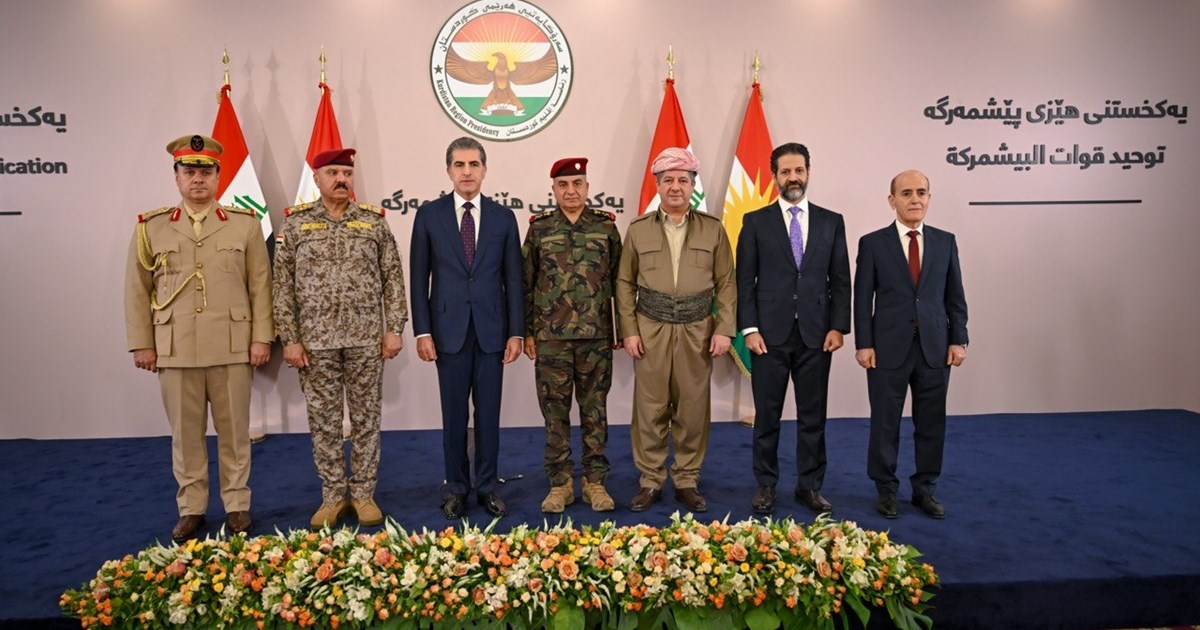
ERBIL, Monday, September 21, 2026 — The unification of Peshmerga forces in the Kurdistan Region was officially announced today in Erbil, placing the 70th and 80th Unit forces under a unified military structure directly commanded by the Ministry of Peshmerga Affairs. The move was described by Kurdistan Region President Nechirvan Barzani as a major milestone in the Region’s institution-building process.
The announcement ceremony took place at the Kurdistan Region Presidency headquarters in Erbil under the supervision of Region President Nechirvan Barzani, in his capacity as Commander-in-Chief of the Peshmerga forces. It was attended by Region Prime Minister Masrour Barzani, the Deputy Prime Minister, the Minister of Peshmerga Affairs, several officials, representatives of the International Coalition and diplomatic missions, as well as the Director of the Office of the Commander-in-Chief of the Iraqi Armed Forces, Abdul-Amir Al-Shammari.
Under the new structure, tens of thousands of Peshmerga troops belonging to the 70th and 80th Units joined a unified national military framework directly commanded by the Ministry of Peshmerga Affairs. The ministry had announced earlier in September the completion of the reorganization process, including the unification of forces within a single command-and-control system.
Speaking at the ceremony, Nechirvan Barzani stated that this step represents “the final phase in unifying the Peshmerga forces and activating the First and Second Commands of the Kurdistan Peshmerga forces,” emphasizing that “no force will remain outside the structure of the Ministry of Peshmerga Affairs.”
He added: “From now on, no force will remain outside the structure of the Ministry of Peshmerga Affairs. Kurdistan needs one force and one command.”
The Region President noted that the upcoming phase might be more difficult, stressing: “We will make the Peshmerga a unified force to protect Kurdistan’s future.”
A Reform Path That Began Years Ago
Nechirvan Barzani linked the unification announcement to the reform process initiated within the Ministry of Peshmerga Affairs in 2016, noting that the process continued over the years, leading to the Memorandum of Understanding signed between the Ministry of Peshmerga Affairs and the U.S. Department of Defense on September 21, 2022.
On September 21, 2022, the United States and the Kurdistan Regional Government signed a Memorandum of Understanding renewing cooperation to support Peshmerga forces in operations against ISIS, while emphasizing the continuation of institutional reforms, professionalization, and reorganization of the forces. The first MOU was signed in 2016.
Nechirvan Barzani noted that the occasion coincides with the fourth anniversary of the MOU signing, adding: “I express my gratitude for their continuous support and assistance to this process and for standing with the Kurdistan Region and Iraq, particularly in the war against ISIS terrorists.”
He also pointed out that the ongoing reform efforts trace back to 2016, “when the reform process in the Ministry of Peshmerga Affairs was launched by President Masoud Barzani.”
He reaffirmed that unification “is not merely a change in structure and organization, or simply transferring units from one formation to another, but a major national step in the journey of building the Kurdistan Region’s institutions,” reiterating that “Kurdistan needs one force, one ministry, and one command.”
Nechirvan: Peshmerga Must Remain Above Partisan Rivalry
The Kurdistan Region President stressed the necessity of keeping the military institution away from political and partisan disputes, saying that “the military institution will not be an arena for political conflict” and that the Peshmerga “is not a partisan force, but a Kurdistani force.”
He added that the success of the unification process is measured not only by the number of units placed under the ministry’s umbrella, but by “the extent to which every Peshmerga feels that their institution is the Ministry of Peshmerga Affairs, their leadership is the military command, and their brother-in-arms in the same unit is their brother in duty, regardless of affiliation or region.”
He stated that the Peshmerga desired by the people of Kurdistan is a “professional, organized, modern, well-trained, and armed force that adheres to the law and institutions, earning the trust of its people and the respect of its friends.”
At the federal level, Nechirvan Barzani affirmed that the unified Peshmerga forces “are part of the defense system of federal Iraq,” considering that enhancing their capabilities and strengthening coordination with the Iraqi Army “serves the security of both the Kurdistan Region and all of Iraq.”
He renewed his call for the Iraqi Federal Government to treat the Peshmerga in accordance with the constitution and the law, to fulfill its commitments toward the forces, and to guarantee their rights and financial entitlements.
Masrour Barzani: Unification Is “The First Phase of a Long Path”
For his part, Kurdistan Regional Government Prime Minister Masrour Barzani described the occasion as a historical milestone for Kurdistan and the Peshmerga, recalling the pledge he undertook since his first day in office—within the Ninth Cabinet’s government program—to make every effort toward unifying the Peshmerga forces.
He stated that the achievement came as the fruit of four years of diligent, intensive work under the joint Memorandum of Understanding with the U.S. Department of Defense, supervised directly by President Masoud Barzani, supported continuously by Region President Nechirvan Barzani, and aided by the Region’s allies, foremost among them the United States and the International Coalition.
Masrour Barzani praised the role played by President Masoud Barzani, saying: “I find it necessary to express with profound appreciation and pride the important role and continuous support provided by His Excellency President Barzani, who spent his life as a national leader and Peshmerga serving Kurdistan, striving to preserve the Peshmerga’s prestige and keep its name high, while closely supervising this unification.”
He also valued the efforts of Region President Nechirvan Barzani, and extended thanks to Deputy Prime Minister Qubad Talabani, Minister of Peshmerga Affairs Shoresh Ismail, Undersecretary Abdul-Khaliq Babiri, Chief of Staff Lieutenant General Issa Ozer, and all officials, officers, ranks, military commanders, and members of the Peshmerga, while commending the International Coalition’s role in defeating ISIS terrorists and preserving the Region’s stability.
He emphasized that unifying the Peshmerga forces represents “the first phase of a long path,” explaining that the upcoming phase will focus on developing their capabilities, providing advanced weaponry and air defense systems, and raising the physical, tactical, and intellectual training standards of personnel in accordance with international military standards.
He said: “The Peshmerga is not merely an armed force; the Peshmerga is a symbol of sacrifice and struggle, the identity of the Kurdistan people’s cause, and a source of pride for every Kurdistani. Its courage and dedication in defending the rights of all components of Kurdistan’s population, and its stand against terrorism in defense of freedom, democracy, and peaceful coexistence, have crowned its timeless record with great heroism.”
Call to Enhance Coordination with the Iraqi Army
At the federal level, the KRG Prime Minister described the Peshmerga forces as a constitutional force, an essential part of the Iraqi defense system, and a guarantee for the security and stability of Iraq and the Region.
He reiterated his support for Federal Prime Minister and Commander-in-Chief of the Armed Forces Ali Al-Zaidi to consolidate security cooperation and coordination between the Peshmerga and the Iraqi Army, calling on the federal government to grant the Peshmerga their constitutional rights and equalize their salaries and financial entitlements with their peers in the Iraqi Army.
Masrour Barzani emphasized the necessity of solidifying national belonging and adherence to military hierarchy and orders, stating: “Political and partisan affiliation is a natural right, but national and Kurdistani belonging must be the standard for the Peshmerga. We want this force to stand above all partisan and personal interests and not to be used as a tool to settle internal disputes; its primary and ultimate goal must be to defend the land and people of Kurdistan without discrimination, remaining, as always, an element of stability and peace in Iraq and the region.”
Concluding his speech, the KRG Prime Minister congratulated the people of Kurdistan on this achievement, saying: “We bow in honor and reverence to the souls of our eternal martyrs, holding immense gratitude for the immense sacrifices made by the families of the righteous Peshmerga martyrs, and for the struggle and sacrifices of our heroic wounded fighters, people with determination, veterans, and retirees.”
Background: From Kurdish Movement Force to Unified Military Institution
The Peshmerga forces emerged as an organized force during the stages of the Kurdish liberation movement, particularly since the outbreak of the September Revolution in 1961 led by Mullah Mustafa Barzani. Following the establishment of Kurdistan Region institutions after the 1991 uprising, the Peshmerga gradually transformed into an official force responsible for protecting the Region.
Unifying the military formations historically affiliated with the Region’s main political parties has been a focal point of military reform over past years. Within this framework, earlier stages saw the integration of several formations and brigades from the 70th and 80th Units into the Ministry of Peshmerga Affairs, while the restructuring process continued until the current announcement of complete unification.
In 2022, the Ministry of Peshmerga Affairs confirmed that reform and modernization efforts included merging a number of brigades under its umbrella, with a plan to complete the full unification of the 70th and 80th Unit forces.
In September 2026, the Ministry of Peshmerga Affairs announced the completion of the unification and reorganization of forces under its umbrella—including the 70th and 80th Units—within a unified command-and-control structure, alongside the formation of military zone commands.
The September 21, 2026 announcement stands as the culmination of this process, with the Region’s leadership and government affirming that the upcoming stage is not limited to restructuring, but extends to enhancing military capabilities, training, armaments, and strengthening coordination with Iraqi federal forces.
Note: This text is translated from the original Arabic version… Read the Arabic version:Click here