The great Kurdish artist Sivan Perwer sang a song titled Kirivê, and the song Sînanê Kirîv by the Kurdish artist Gulistan became famous. In both songs, the story of a forbidden love between two young people appears, one Yezidi and the other Muslim, whose families belong to a “Kiriva” relationship. The barrier was not blood kinship, nor a legal or religious ruling, but rather a kinship created by society itself, which was then given enough power and sanctity to make marriage between the children of the two families a customary taboo, as if they were brothers and sisters.
I knew Kiriva as an old social custom in Kurdish society, and I personally was a subject of it in my childhood, but reading about it in the context of historical relations between Kurds and Armenians made me see it in a completely different way. Behind a seemingly simple ritual lies, in my opinion, one of the most fascinating social institutions produced by the societies of the region.
I am not a specialist in history, and what I present here is not an attempt to rewrite or document facts, but preliminary thoughts and questions from someone looking at historical phenomena through the lens of institutional political economy, particularly interested in how societies learn, produce their institutions, and develop them over time.
What is Kiriva?
Kiriva is primarily connected to the ritual of a child’s circumcision. The child’s family chooses a person to be the “Kiriv,” who usually contributes to some of the occasion’s expenses, but his most important symbolic role appears during the circumcision itself: he takes the child in his lap and holds him during the procedure. The circumcision process ends, but the Kiriva relationship begins from it. The ritual creates a kind of nominal kinship between the two families. The Kiriv and his family become relatives of the family, and mutual rights and obligations arise, including visiting, hospitality, assistance in hardship, mediation, and protection. Refraining from helping the Kiriv and his family in some environments exposed a person to social blame. The strength of this kinship goes so far that marriage between members of the two families becomes, in many areas, a customary taboo, despite the absence of real blood kinship.
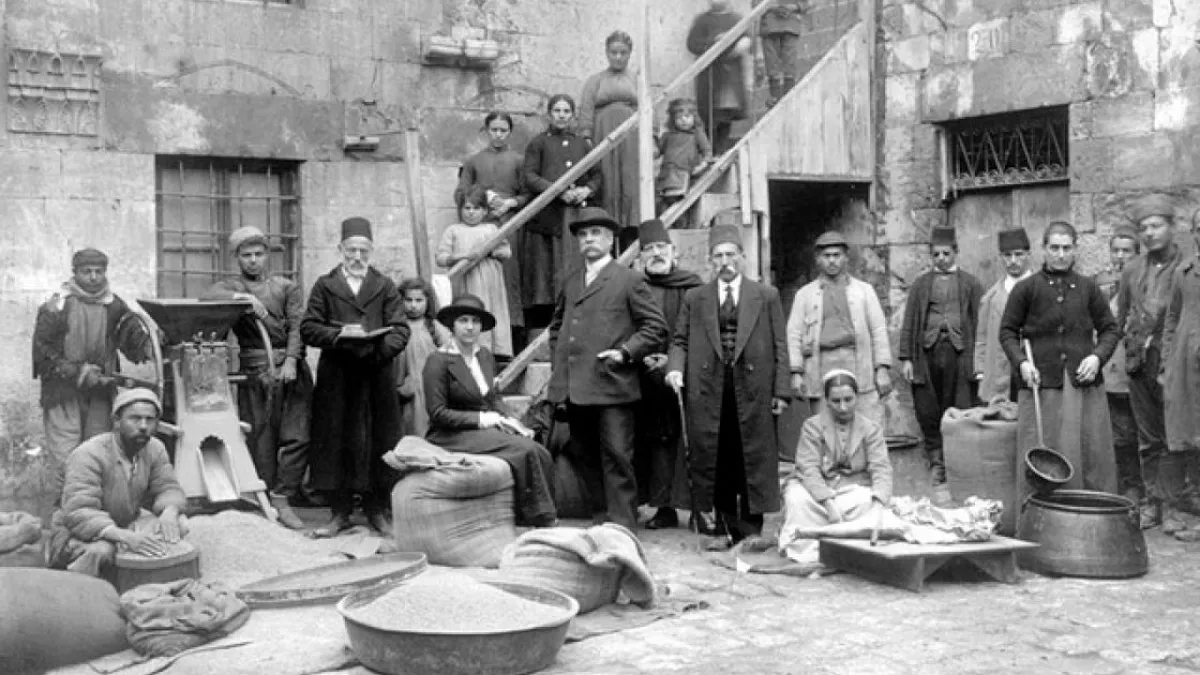
However, what is even more fascinating is that Kiriva was not always between members of the same group. In Diyarbakir, its surroundings, and other regions, the studies I was able to examine showed numerous evidences of Kiriva between Muslim Kurds and Christian Armenians, and similar relationships were also known among other religious and ethnic groups in the region.
And here begins the story that truly captures my admiration.
An Institution Transcending Religion and Blood through Religion and Blood
Religion, kinship, and tribe were among the most established institutions in the societies of the region, each drawing, to varying degrees, boundaries between the inside and the outside. Yet Kiriva did not attempt to demolish these institutions in order to transcend their boundaries. Society did something much smarter: it used their very resources to build a new bond. It took from religion the sanctity of the circumcision ritual and the power of obligation, and from kinship the meaning of brotherhood, protection, and marriage taboos, then reassembled these elements to produce a kinship with a human being who might be outside religion, blood, and tribe. Here, for me, lies the genius of Kiriva: society used religion to build a bond capable of crossing the boundaries of religion, and used the logic of kinship to build a kinship that transcends blood.
No one laid down a theoretical blueprint for it, nor was it designed by a governance expert. It is, most likely, the result of a long accumulation of experience, need, and learning. Perhaps this can be called “distributed institutional intelligence”—that is, knowledge not monopolized by an elite or a state, but formed among people through their repeated attempts to solve the problems of their lives.
Integration without Assimilation
In the context of the economics of migration and asylum in Germany, I studied much of the debate around the difference between Integration and Assimilation: how can a newcomer participate in society without losing their identity and distinctiveness?
Kiriva makes me look at this question with even greater admiration for the local communities’ capacity for innovation. It did not ask the Armenian to become a Muslim or a Kurd to be trusted, nor did it ask the Kurd to become an Armenian. Both remained different, yet they established a third shared bond. Therefore, Kiriva is not merely coexistence. Coexistence might mean that I live next to you and do not encroach upon you. Kiriva, however, says something stronger: I can remain different from you, yet you acquire rights over me and obligations towards me, and I towards you likewise.
In today’s language, we might call this Institutional Bridging: instead of removing boundaries between groups, we build institutions capable of crossing them.
But why did Kiriva not become something larger?
Here, my admiration for the institution turns into a question. If Kiriva managed to transcend two of society’s strongest boundaries—religion and blood—why did it not develop into broader networks and institutions organizing relations between the groups themselves?
Perhaps the problem lay within Kiriva itself. Here, a question interests me that I have not yet reached a decisive answer to: was the Kiriva relationship actually inherited across generations, and to what extent? The tribe reproduces itself through blood, and religion possesses the family, the ritual, the religious institution, and education. As for Kiriva, if it needed to re-establish the relationship in every generation, it might be extremely strong horizontally in connecting those who are different, but weaker vertically in reproducing itself over time. Yet there is another possibility worth considering.
Perhaps we should reconsider the image of Kurdish society during the Ottoman modernization period (the nineteenth century) as merely a “traditional” society whose institutions were waiting to be replaced by those of the modern state. It seems that society was managing its life through a diverse institutional environment. The tribe provided a measure of organization and protection; Sufi orders created networks capable of transcending tribal and regional boundaries; and Kiriva was capable, in important cases, of transcending the boundaries of blood, religion, and ethnicity itself. This does not mean that Kiriva was “superior” to the other two institutions, but it was perhaps more capable of bridging those who were different.
So what happened to this capacity?
Does Centralization Take Only Power, or Does It Take Learning with It?
With the dismantling of the Kurdish emirates and the growth of Ottoman centralization in the nineteenth century, increasing political and organizational functions shifted from the local sphere toward the center. At the same time, an important portion of the modern Kurdish political and cultural elites came to practice their activity and produce their ideas in Istanbul.
I do not yet possess enough to transform the relationship between these transformations and the fate of Kiriva into a definitive historical conclusion. I therefore pose it as a question and a hypothesis worthy of research. We usually look at centralization as a transfer of power. But what if it was also a transfer of the locus of learning?
A society that resolves its conflicts learns how to resolve conflicts. One that organizes exchange learns cooperation. One that produces part of its security learns organization. And one that faces its differences daily is forced to innovate institutions to manage them. That is, performing a function is not merely producing an output; it is also a learning process. When the function shifts to an entity far removed from society, society may not only lose its authority over it, but also part of the opportunities to experiment, learn, and develop its institutions.
Then came the Republican nation-state (Atatürkism in particular) with a more profound project that was not limited to monopolizing political functions, but extended to language, education, identity, culture, and the public sphere. At the same time, the Armenian presence itself was subjected to uprooting on a massive scale. Here, perhaps it was not Kiriva alone that suffered damage, but the social environment that was capable of producing and reproducing it. The tribe can persist through blood, and the order can persist through religion, but Kurdish-Armenian Kiriva requires a Kurd and an Armenian, along with proximity, interaction, and mutual dependence.
Hence, the question becomes larger than the fate of an ancient social custom: can the confiscation of society’s functions lead to weakening its capacity for learning itself? And was the decline of institutions like Kiriva a result of their internal weakness, or a result of a broader transformation affecting the environment that produced institutional innovation from below?
I do not have a final answer. But Kiriva makes me less reassured by the simple narrative that views modernization as a transition from a “traditional society” to a “modern state.” The society we call traditional may be more capable of learning and innovating than we assume, and some modernization processes may carry, alongside what they build, a hidden cost represented in disabling the distributed institutional intelligence within society.
Perhaps the question that Kiriva deserves to leave us with is: how many possible institutions do we lose when centralization strips local communities of their functions and spaces for experimentation? And how many opportunities for learning and innovation could decentralization open up when it leaves society sufficient space to organize some of its affairs, learn from its successes and failures, and innovate its institutions and its future?
Source: Madarat Kurd
Note: This text is translated from the original Arabic version… Read the Arabic version:Click here