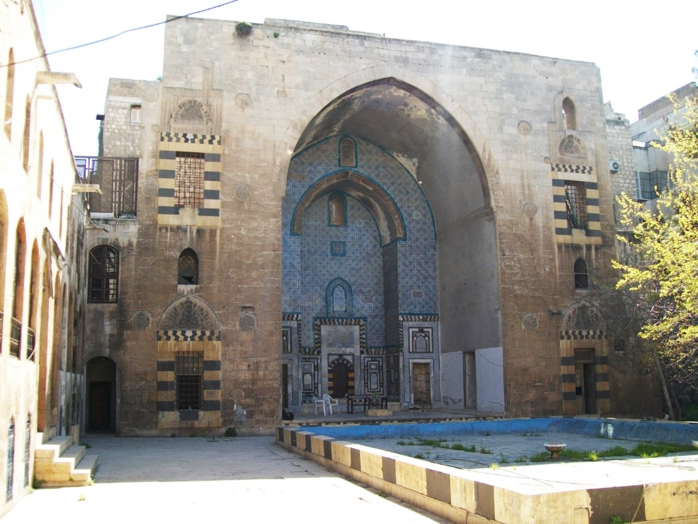
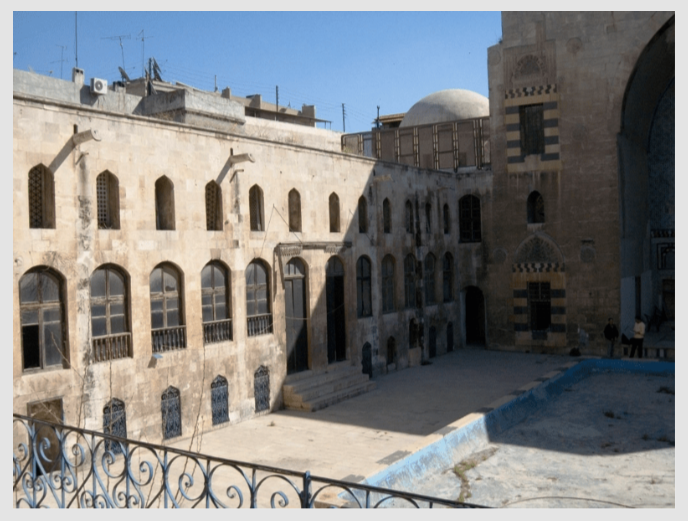
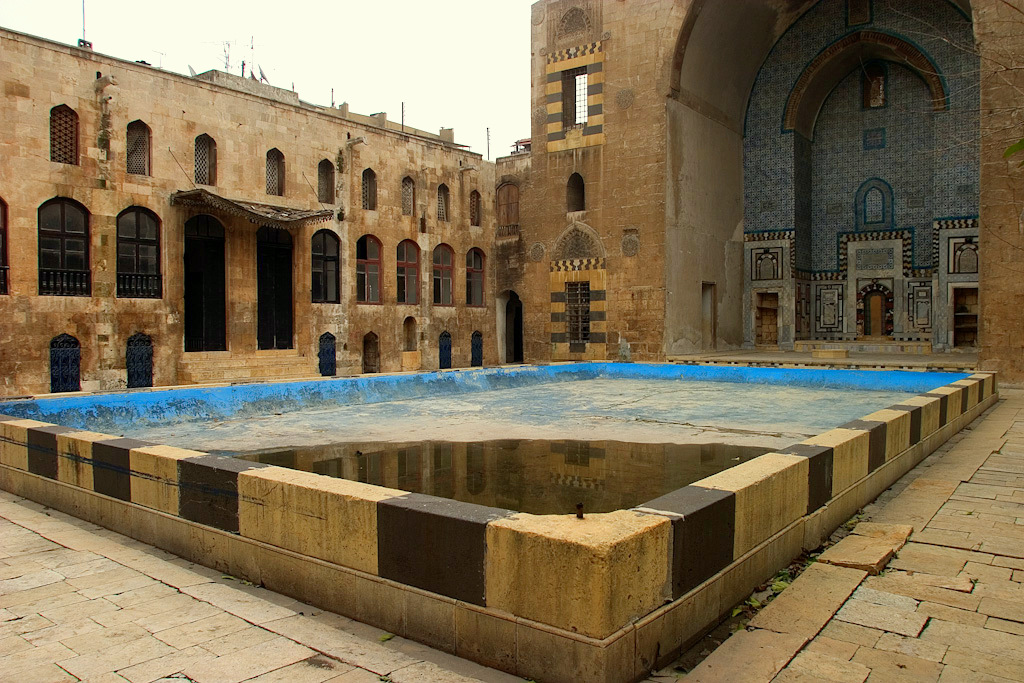
Dar Jan Polad (Junblat) is one of the most important historical landmarks in the city of Aleppo. It is an architectural masterpiece, towering at a height of 30 meters, with a magnificent iwan considered one of the largest in Syria, astonishing in its beauty, grandeur, and intricate details, adorned with panels of blue faience. It is a residence that matched the ambition of the prince, the solidity of his power, and the extent of his influence—a residence unparalleled in the Arab countries. It was offered for sale for the sum of one billion Syrian liras in 2011.
The Kurds have a significant cultural heritage in the city of Aleppo, most of which dates back to the Ayyubid era, such as the Citadel, the Queiq River, the gates, the schools, the mosques, the khanqahs, and other beautiful landmarks that contributed to the development of Aleppo in various aspects. Furthermore, during the Ottoman era, the Kurds also left a notable cultural imprint on the growth of Aleppo, and among the most important of these historical landmarks is the palace of the Kurdish Prince Janbulad.
On a plot of 5,000 square meters, near Bab al-Nasr, one of the gates of the city of Aleppo, stands the palace of the Kurdish Prince Janbulad ibn Qasim Bek ibn Ahmad Bek al-Qusayri, who ruled the Emirate of the Kurds in the Aleppo district during the reign of Sultan Suleiman the Magnificent (1520–1566 CE). The palace is located in the al-Bandara neighborhood, south of the Citadel. “Before its construction, this site contained several houses belonging to the Banu al-Asba’; Janbulad purchased them, and bought other houses around them, demolished them all, and built a single palace in their place. It was said that he spent between 20,000 and 25,000 gold dinars on it at that time.”
Al-Tabbakh states in his book A’lam al-Nubala’ bi-Tarikh Halab al-Shahba’ (The Notables in the History of Aleppo the White): “This house is one of the grand old houses in Aleppo, located in the Bandarat al-Islam neighborhood. It was known as Dar Ibn Abd al-Salam and later came into the possession of Sheikh Hassan Efendi al-Kawakibi, the Mufti of Aleppo” (Al-Tabbakh, 1926, p. 90). Numerous annexes were built for the palace, including military barracks, servants’ quarters, stables, and other necessary dependencies. However, all of these annexes were demolished in the 1960s.
A vast, rectangular-plan, spacious courtyard occupies the center of the palace, with its shorter sides lying to the north and south. This immense courtyard contains a large rectangular water basin, which scholars consider the largest basin in the old houses of Aleppo. The length of its long side is 20 meters, while its other side measures 12.5 meters. Its stone edges rise about one meter above the courtyard floor. It is surmounted at the top by an entablature of large, colored yellow and black stones, bound together by iron clamps that add to the depth of the basin. At the center of the basin is a fountain in the shape of a stone cup from which water flows. Beneath this basin lies a cistern for water storage, extending over the same area as the basin itself. (https://arab-ency.com.sy/archeology/details/166601)
Al-Ghazzi, the historian of Aleppo, mentioned it in his chronicle of the events of 1918 CE, when he went with the French General Allenby to Dar Junblat. Al-Ghazzi says: “He was exceedingly delighted upon seeing its iwan. I showed him a piece of stone from a salsabil, part of which was buried in the ground, featuring such exquisite craftsmanship that it bore witness to the past’s mastery of engravings and architectural skill. He bent down to extract that stone from the ground, and some of those present assisted him, so it was extracted. I informed him that some Western archaeologists had requested to purchase this stone from the house’s owners and had offered a hundred Ottoman gold coins for it, but they refused to sell it. General Allenby then said to those present from the house’s family: ‘Beware of selling it to anyone, for if I hear that you have sold it to anyone, I will impose a large fine upon you.'” (Al-Ghazzi, 1926, pp. 711-712). Furthermore, Dr. Lamia al-Jasser stated: “The facade of the iwan is located on the northern side of the courtyard, and there is a recess that once contained a salsabil, the front of which was covered with faience tiles similar to those found in this iwan. It was transferred to the garden of the National Museum in Aleppo, and this salsabil was mistakenly attributed in the records of the Directorate of Antiquities to Qastal al-Ramadaniyya. I conducted research on this salsabil located in the garden of the National Museum in Aleppo and was able, through it, to prove its attribution to Dar Junblat.”