Ph.D. in Philosophy, Heidelberg University, Germany
In truth, history is not merely a successive tracking of facts and events, but rather, from a philosophical perspective, an arena in which wills clash to weave the identities of nations and forge their major transformations.
Based on this intellectual vision, the emergence of exceptional historical leaderships does not occur through emergency geopolitical coincidences, but rather springs forth as a historical necessity embodying the overwhelming tendency of peoples toward freedom, survival, and the full extraction of legitimacy.
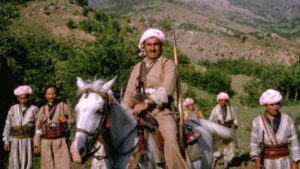
Against the backdrop of the complex geopolitical transformations witnessed by the modern Middle East, the presence of the spiritual father of the Kurdish nation, Mustafa Barzani, transcends the dimensions of a field military commander who fought battles in the mountains of Kurdistan.
For his existence was embodied as a strategic architect and philosopher of the Kurdish national doctrine, and a historical leader who was able, with supreme wisdom and exceptional charisma, to transition the liberation movement from its narrow traditional frameworks into the vast space of an organized political and diplomatic movement with a comprehensive national horizon.
When the region was left vulnerable to unfair divisions and fragile maps following the collapse of the Ottoman Empire and the conclusion of the Treaty of Lausanne in 1923, which voided the promises of the Treaty of Sèvres of 1920, the leader Mustafa Barzani formulated a steadfast doctrine based on the inherent right to self-determination, transforming the Kurdish cause from local problems and scattered regional rebellions into a just cause with an indelible regional and international dimension.
The national charisma of the leader Mustafa Barzani was manifested in his unique ability to unify the Kurdish social fabric and transcend the tribal and regional divisions that regional powers had long exploited to divide Kurdish ranks, as he succeeded in blending authentic social and spiritual heritage with modern political consciousness, becoming an unifying symbol around which various spectra of society rallied.
On the diplomatic level, the vision of the leader Mustafa Barzani during the Cold War era represented an advanced model of political pragmatism and a deep understanding of sensitive international balances.
Despite the sharp polarization between the Western and Eastern camps, the leader Mustafa Barzani dealt with that equation with parity and political realism serving the supreme interest of his people, starting from his pivotal participation as the highest military commander in the Republic of Mahabad in 1946, and the arduous historical march that followed, embodied in his famous march toward the Soviet Union with hundreds of his comrades—a stage he leveraged between 1947 and 1958 to hone his political and military skills and develop the organizational thought of the Kurdistan Democratic Party, so that upon his return to Iraq after the Revolution of 14 July 1958, he established a solid, disciplined core historically known as the Peshmerga forces, which became the eternal symbol of courage and defense of the Kurdistani existence.
And when the Soviet Union reneged on supporting the aspirations of the Kurdish people to solidify its interests with central governments in Baghdad, the leader Mustafa Barzani took a courageous decision to reorient his diplomatic compass toward openness to the Western camp, the United States, and the international community, proving his supreme ability to accurately read geopolitical changes and avoid being hostage to a single ideology. Despite the monumental challenges and international conspiracies woven by intersecting interests—especially the ill-fated Algiers Agreement of 1975 signed between the Shah of Iran and the Iraqi government, which put the revolution to a severe and temporary test—that era laid the primary and firmest cornerstone for the path of Kurdish diplomacy and constituted a pivotal turning point proving that Kurdish national will is impervious to final defeat.
In the modern era, the doctrine of the leader Mustafa Barzani and his struggle legacy shine as a strategic beacon guiding the path of the Kurdistan Region and its constitutional institutions; national unity, protecting the independence of political decision-making, balancing diplomatic relations with regional and international powers, and linking the national struggle to democratic and human values all form a living continuation of his philosophy, which paved the way for the 1991 uprising and the establishment of the first recognized constitutional and political entity for the Kurdistan Region.
In conclusion, a comprehensive philosophical and analytical reading of this immortal legacy confirms that the political and diplomatic thought of the leader Mustafa Barzani was not a mere reaction resulting from historical circumstances, but rather a self-contained school of thought that established the concepts of sovereignty, historical right, and international legitimacy, ensuring that his doctrine continues as an unshakeable scientific and political pillar that makes Barzani the soul of the nation and the immortal symbol whose name is engraved in the consciousness of successive generations that believe in freedom, sovereignty, and a dignified life.
Note: This text is translated from the original Arabic version… Read the Arabic version:Click here