“Blessed are the peacemakers, for they shall be called children of God.”
— Gospel of Matthew 5:9
The roots of the Christian presence in the Kurdistan Region of Iraq strike deep into the human and civilizational history of Mesopotamia. Transcending the boundaries of traditional geographical coexistence, it forms a cohesive spiritual and social fabric spanning long centuries of time. The Christian presence in the mountains and valleys of Kurdistan was never accidental or transient; rather, it has been an authentic part of the region’s historical identity and cultural landscape. Here, ancient churches and monasteries interacted with local Kurdish communities in a shared human destiny, language of the land, and common living.
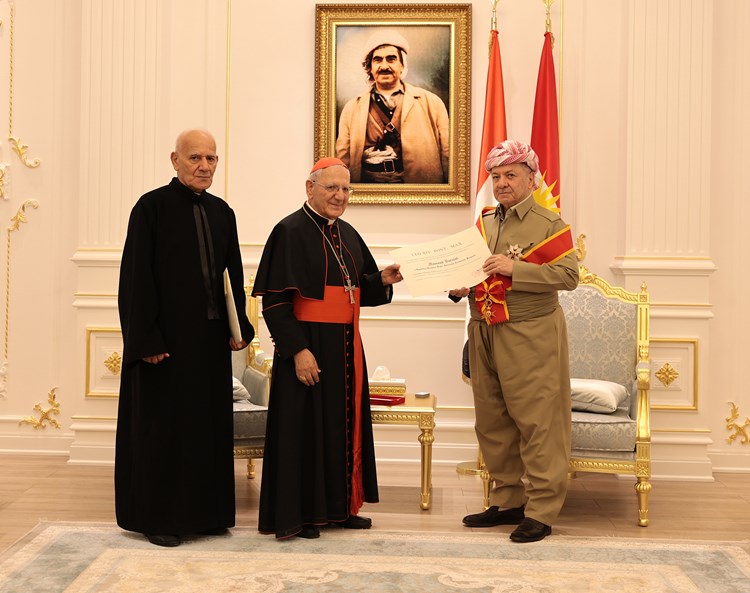
Over successive eras, strong bonds were forged between Christians and Kurds built upon mutual respect, the protection of the vulnerable, and emotional solidarity in the face of historical challenges and turns. This interconnectedness found its most beautiful manifestation in the modern era through the high Holy See’s appreciation and honoring of a veteran Kurdish leadership figure with an exceptional sovereign papal order. This gesture expressed deep gratitude for the safe environment and humanitarian haven the Region provided to Christians and the distressed, establishing a unique spiritual and social atmosphere that has made Kurdistan an oasis of human fraternity and creative diversity, enriching the conscience of the entire region.
The Status of the Church in the Kurdistan Region of Iraq (According to Foreign Sources and Literature)
Historical Depth and Eastern Roots: The study and analysis of foreign historical and diplomatic sources—particularly literature issued by Syriac studies centers and reports from international heritage protection and human rights organizations—demonstrate that the Church in the Kurdistan Region of Iraq does not merely represent an incoming or transient religious group. Instead, it is considered an Indigenous Component of the Mesopotamian Civilizational Fabric. The roots of the Christian presence in this region date back to the First Christian Centuries, specifically to early times through the missions of the Historical Church of the East. It successfully preserved an ancient linguistic and cultural heritage, foremost among which are the Syriac and Aramaic languages, whose roots are closely tied to the region’s early historical era.
Spiritual and Societal Weight: The weight attributed to the Church in these sources is not limited to purely spiritual dimensions, but extends to encompass a vital institutional and societal role. Its features are manifested in managing educational, healthcare, and charitable institutions, as well as representing an established spiritual and cultural authority. The importance of this role stands out clearly in Western diplomatic reports and international religious freedom committee reports that document the security and political reality of Christians in the Region.
These reports note with great appreciation that, historically and in contemporary times—especially during major crisis points and the displacement of hundreds of thousands of Christians from central/southern Iraq and the Nineveh Plains—the Kurdistan Region constituted a safe haven and an oasis of stability. This prompted international institutions and the Holy See – The Vatican to repeatedly praise the Coexistence and Safe Haven Approach provided by the local environment and official institutions in the Region. Thereby, the Church in Kurdistan gains its exceptional status as a fundamental pillar of diversity, coexistence, and the protection of human and historical identity across the broader region.
Types of Churches in the Kurdistan Region of Iraq and Their Structural Distribution
Ecclesiastical Diversity and Spiritual Families: Specialized demographic and ecclesiastical studies on Iraqi and Eastern Christian affairs affirm that the religious map in the Kurdistan Region is characterized by a rich diversity comprising various ancient church families. This Christian presence is spread across the Region’s main cities—such as Erbil, Duhok, and Sulaymaniyah—with a prominent demo-geographical and cultural concentration in the Ainkawa district, which represents a vital center of gravity for Christians in the region. These churches are distributed according to the following theological classifications and traditions:
The Catholic Churches: This family constitutes the largest demographic share of the Christian presence in the Region, led by the Chaldean Catholic Church, which represents the largest weight in terms of numbers and organization. Alongside it, other denominations actively exist, such as the Syriac Catholic Church, the Armenian Catholic Church, and the Latin Church, all of which are bound in full communion with the Holy See in the Vatican.
Churches of the East and Orthodox Communities: These churches hold a unique historical and theological position due to their direct connection to early Syriac and Eastern heritage. This category includes the Assyrian Church of the East and the Ancient Church of the East, alongside the Syriac Orthodox Church and the Armenian Orthodox Church, which are distinguished by their ancient rites and their preservation of ancient liturgical languages.
Evangelical and Protestant Churches: Alongside traditional churches, the Region hosts an active presence of various evangelical and protestant denominations, including Baptist, Presbyterian, and National Evangelical assemblies, which in turn contribute to enriching the diverse spiritual and societal landscape within the cities of the Kurdistan Region.
The Oldest Historical Churches and Monasteries in the Kurdistan Region of Iraq and Their Living Landmarks
Western and local historical and archaeological sources concerned with preserving Eastern Christian heritage indicate that the Kurdistan Region of Iraq is rich in spiritual landmarks and ancient monasteries dating back to the early periods of Christian history in the first millennium AD. These landmarks are not merely places of worship, but living testaments to the civilizational and historical depth of the Christian presence in Mesopotamian Heritage.
Among the most prominent and important of these historical monuments documented in archaeological literature is St. Rabban Hormizd Monastery, which is considered one of the most important and oldest historical monasteries in the region and the Christian world. Its founding dates back to around 626 AD (the 7th century AD). It was constructed and carved with extraordinary engineering skill into the heart of the rugged mountains near the town of Alqosh. For many centuries, it served as a major spiritual and cultural center, a historical patriarchal seat for the Historical Church of the East, and a reference repository for preserving Syriac and Aramaic heritage manuscripts.
In addition, Sulaymaniyah Governorate holds immense importance on the map of Christian antiquities. Studies document the existence of remote monasteries and churches dating back to the Sasanian Era and Early Christian Period. Among the most prominent of these physical testaments are the Bzyan Church Ruins, located on the outskirts of Sulaymaniyah, which provide conclusive physical and archaeological evidence of the deep historical spread of Christianity and monasticism within the region’s mountains and valleys. Furthermore, the historical area surrounding the city of Shahrizor bears witness to the presence of early Christian communities where ancient bishoprics of the Church of the East were active.
In the heart of Sulaymaniyah, St. Mary Church in Sulaymaniyah stands out as the oldest church built in the modern city of Sulaymaniyah, dating back to 1862 AD. It was erected in the historic Sabunkaran neighborhood during the reign of Chaldean Patriarch Joseph VI Audo. In terms of ecclesiastical affiliation and administration, the church originally belongs to the Diocese of Kirkuk and Sulaymaniyah of the Chaldean Catholic Church. In 2012, its monastic management was entrusted to the ecumenical Community of Al-Khalil under the supervision of Fr. Jens Petzold, turning it into a unique center for dialogue, spiritual and human rapprochement, and open humanitarian and cultural activities for all without discrimination.
Alongside these sites, other ancient churches in the Region’s cities maintain their spiritual and societal continuity, such as St. George’s Ancient Church in the Ainkawa district and Mar Ith-Alaha Church in Duhok Governorate, reflecting a unique architectural style that blends Eastern ecclesiastical arts with local traditions of construction, preservation, and heritage.
Roots of Papal Orders and Their Sovereign and Diplomatic Significance in Kurdistan
The mechanism of conferring high honors within the supreme hierarchy of the Holy See in the Vatican rests upon ancient traditions whose organizational roots date back to 1847 AD, thanks to Pope Pius IX. This formed a precise institutional system operating through an administrative sequence and documented reports submitted by papal nunciatures to honor peacemakers.
This approach is clearly embodied in the direct recognition of the leadership of the Kurdistan Region through the conferral of high papal honors, such as the Order of Pope Pius IX at the rank of Knight Grand Cross. This comes in appreciation of the Region’s role in providing a safe haven and stable refuge for hundreds of thousands of Christians and displaced persons, transforming church initiatives into an instrument of spiritual diplomacy that recognizes a pioneering role in safeguarding Christian heritage and establishing peaceful coexistence in the Middle East.
Future Prospects for Partnership Between the Kurdistan Region and the Holy See and the Sustainability of Dialogue
When reading the future landscape of relations between the Kurdistan Region of Iraq and the Vatican, eyes turn toward broader horizons of institutional and diplomatic cooperation, especially amidst the accelerating challenges facing diverse communities in the Middle East. Strategic analyses and reports affirm that sustaining this constructive dialogue and spiritual-humanitarian partnership requires strengthening joint frameworks for protecting Eastern Christian heritage and supporting educational and cultural initiatives that embed the culture of coexistence within curricula and public institutions.
Furthermore, the active presence of ecclesiastical and monastic institutions—foremost among which are the open humanitarian and spiritual activities sponsored by churches and monasteries across the Region’s cities—serves as an essential pillar to ensure that Christians remain a vital and active component of their historical homeland. Hence, the continued harmony between political/societal will in Kurdistan and the diplomatic vision of the Holy See opens the door to a unique model of sustainable peaceful coexistence, making the Region a regional benchmark in preserving human dignity and protecting religious and cultural pluralism for generations to come.
The Order of Pope Pius IX (Ordine Piano) — Historical Roots, Organizational Structure, and Diplomatic Significance
Western, historical, and papal sources concerned with studying sovereign honors in the Vatican—particularly literature issued by order documentation centers such as The Christian Knighthood Information Center and official documentation outlets of chivalric institutes—indicate that The Order of Pope Pius IX, known in short as The Pian Order or Ordine Piano, is considered one of the highest and most prestigious papal orders conferred by the Holy See.
Its original foundation dates back to 1565 AD during the reign of Pope Pius IV, before being revived and reorganized in its modern form on June 17, 1847, by Pope Pius IX. This order holds a high status as the highest active and operational papal order currently awarded by the Holy See, given that historically superior orders, such as the Supreme Order of Christ and the Order of the Golden Spur, have become dormant and are no longer conferred in the modern era. The order carries an ancient Latin motto: Virtuti et Merito (translated into English as For Virtue and Merit), reflecting its core philosophy of honoring the global elite.
The organizational hierarchy and rank structure of this sovereign order progress upwards from lowest to highest according to precise classes outlined in English sources:
Knight / Dame: The foundational rank.
Commander
Commander with Star / Grand Officer
Grand Cross: Typically awarded to accredited ambassadors to the Vatican or prominent international figures.
Knight / Dame Grand Collar: The absolute supreme rank, reserved exclusively for monarchs, heads of state, and exceptional global personalities.
Regarding the mechanism of issuance and diplomatic documentation, Vatican literature and historical encyclopedias emphasize that the order is not a common or ordinary award. Rather, it is a sovereign diplomatic decree issued by the Holy See, formalized through an official document or papal brief usually drafted in Latin and bearing the signature of the Secretary of State of the Vatican on behalf of the Pope. What distinguishes this order is its inclusive character: it is awarded to both Catholics and non-Catholics who perform outstanding services to the Catholic Church and humanity as a whole, with its organizational scope expanded since 1994 to include women with the title of Dame at the same ranks as men.
Political and Diplomatic Dimensions of Honoring Leadership in the Kurdistan Region
In confirmation of what was previously detailed regarding the sovereign and historical nature of the Order of Pope Pius IX and its precise selection and documentation standards, applying this framework to the contemporary reality of the Kurdistan Region of Iraq raises fundamental questions about the nature of this partnership and the intersections between humanitarian church work and political decision-making.
When examining the conferral of this high order upon prominent leadership figures in the Region—foremost among them the Kurdish leader Masoud Barzani—the philosophy adopted by the Holy See in the Vatican becomes clearly evident. The Vatican completely distances itself from involvement in narrow partisan rivalries or political conflicts, preferring to adopt what can be described as Spiritual and Humanitarian Diplomacy.
According to papal diplomatic protocol, this sovereign honor does not represent a traditional political alliance or bias in favor of one party over another. Rather, it is a high-level institutional and moral recognition of the exceptional humanitarian response and safe environment provided by the Kurdistan Region to millions of Christians and displaced persons who sought refuge in its cities, escaping the brutality of terrorist organizations and armed conflicts in central/southern Iraq and the Nineveh Plains.
From this perspective, the political and administrative decisions of local leadership to provide shelter, protection, and freedom of worship become criteria of merit appreciated by the Holy See. The honor thus serves as an international and moral document of recognition, affirming that protecting religious and cultural pluralism and preserving human dignity are the supreme values upon which the Vatican bases its evaluations and honors for peacemakers around the world—without losing the exceptional character directed toward those who have left a lasting imprint on protecting Eastern Christian heritage.
Note: This text is translated from the original Arabic version… Read the Arabic version:Click here