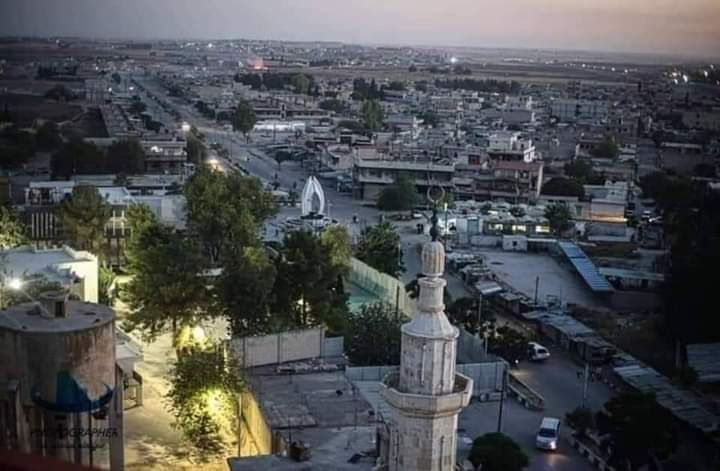
The peoples who inhabited Serê Kaniyê gave it several names, all of which revolved in meaning around the presence of the water springs that characterized the region. The Kurds named it Serê Kaniyê, which the Arabs translated into Ras al-Ayn, and among the Syriacs it was Rish Ayna.
Historically, the name is also Kurdish: Washukani, meaning “the delicious spring.” It was the capital of the ancient Kurds—the Hurrian-Mitanni Empire in 1600 BCE—at the archaeological site of Tell Fekheriye, which belongs to the civilization of Girê Khelif (i.e., “Tell Halaf”).
During the Assyrian era, it was called Guzana, Razina, or Rasin; Theodosiopolis during the Roman era; and during the arrival of the Arab Islamic armies, it was named Ayn Warda. The reason for the abundance of names for this ancient Kurdish city stems from the succession of foreign authoritarian cultures that controlled it, while the name Washukani endured throughout other successive civilizations, such as the Medes, the Greek Hellenistic era, the Achaemenids, and the Sassanids.
The city enjoys a prominent strategic location in the north of Hasakah, situated in the northeastern part of Syria—specifically on the border between Northern Kurdistan in Turkey and Rojava in Syria. It is approximately 85 km from the city of Hasakah and over 90 km from the city of Qamishlo. To its east lies the city of Amuda, about 85 km away, and to its west is the city of Girê Spî, about 125 km away.
During the division of Kurdistan, the city was torn apart into two parts: Ceylanpınar in the north, and Serê Kaniyê in the south.
Area and Population
The population of the area exceeds 150,000, with about 40,000 residing in the city center, while the remainder is distributed among the surrounding villages, which number more than a hundred. Its administrative area covers 3,826 square kilometers.
Ancient History
The city’s history extends back to ancient times, connected to the ancestors of the Kurds—from the Hurrians, Gutians, Lullubi/Guti-Judi, Subarians, and Mitannians, and even the Medes.
Some Archaeological Sites in the Serê Kaniyê Region
– Tell Fekheriye: The location of the ancient city of Washukani, situated at the archaeological site of Girê Qahfakan (Tell Fekheriye). It is a historical site where excavations have not yet been completed, full historical facts about it have not yet been reached, and historical truths remain incomplete due to their scarcity caused by the authorities preventing adequate excavations owing to its connection to Kurdish history.
– Tell Halaf: Excavations there have revealed archaeological strata, pottery and copper assemblies, numerous artifacts, a palace, a temple, buildings with decorated basalt walls, sculptures, and painted ceramics dating back to the Paleolithic era and the 5th and 4th millennia BCE in the Neolithic period—specifically around 4800 BCE—and later to the Hurrian, Subarian, Mitanni, and Assyrian states, among others.
The oldest cultural manifestation at the site is revealed by archaeological discoveries, indicating the presence of an active, industrious, and highly cultured people known to history as the Subarian people—one of the ancient ancestors of the Kurds who established a state extending from the heart of Kurdistan in the middle of the 4th millennium BCE (around 3500 BCE). This was followed at the site by the Hurrian and Mitanni cultural periods.
– Girê Zira (Tell al-Dhab): An archaeological mound located in the southern countryside of Serê Kaniyê.
The Arrival of Islam in Serê Kaniyê and its Surrounding Regions
We summarize what the scholar Ibn al-Athir al-Jazari mentioned in his book Al-Kamil fi al-Tarikh (The Complete History):
“Iyad ibn Ghanm marched to Al-Jazira in the year eighteen [A.H.] in mid-Sha’ban with an army of five thousand, with Sa’id ibn Amir ibn Hazim al-Jumahi on his right wing, Safwan ibn al-Mu’attal on his left wing, and Hubayrah ibn Masruq leading his vanguard. Iyad’s vanguard reached Raqqa, raided the farmers, and besieged the city. Iyad dispatched raiding parties, which brought him captives and supplies. He besieged it for six days until its people sought peace, so he made peace with them regarding their lives and property. Iyad said: ‘The land is ours; we have trodden upon it and possessed it,’ so he left it in their hands.”
He imposed the land tax (Kharaj) and the poll tax (Jizya) upon the inhabitants. After Edessa (Al-Ruha)…
“then he came to villages along the Euphrates, namely the bridge of Manbij and the surrounding areas, conquered them, and marched to ‘Ras al-Ayn’—which is Ayn Warda (meaning Serê Kaniyê here). It resisted him, so he left it and marched to Tell Mawzan (i.e., Girê Mozan near Amuda), conquering it under the peace terms of Edessa in the year nineteen.”
And he states on page 535:
“It was said that Iyad sent Umayr ibn Sa’d to Ras al-Ayn (i.e., Serê Kaniyê), and he conquered it after fierce fighting. It was also said that Umar sent Abu Musa al-Ash’ari to Ras al-Ayn after Iyad’s death, and it was said that Khalid ibn al-Walid was present at the conquest of Al-Jazira alongside Iyad…”
Regarding this conquest, Prof. Dr. Hakim Ahmad Khoshnaw also states:
“Raqqa was conquered peacefully, whereas the city of Ayn Warda (Serê Kaniyê) initially held out against the Muslim commander Umayr ibn Sa’d, but after fighting, it was conquered through a treaty. Serê Kaniyê also resisted Iyad ibn Ghanm, so Umayr ibn Sa’d conquered it after its people put up fierce resistance against the Muslims. The Muslims entered it by force, and then the Muslims made peace on the condition that the land be surrendered to them and the Jizya was imposed per capita, four dinars per head…”
Ronahi Newspaper
Note: This text is translated from the original Arabic version… Read the Arabic version:Click here